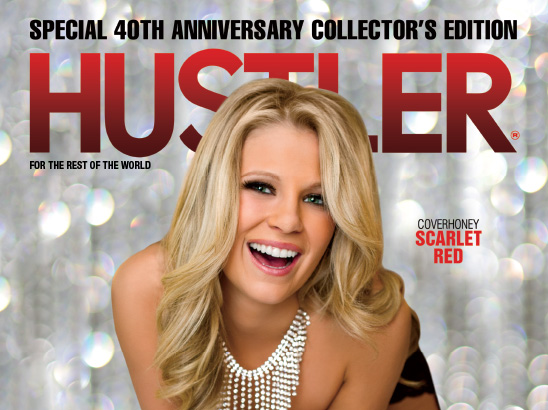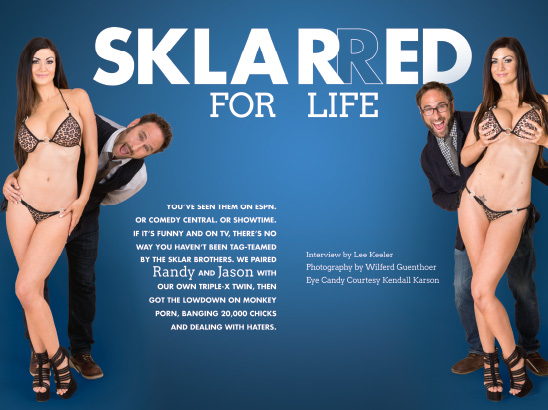
Ninety of the two hundred and six projects in my archive carry the same client name: Hustler Magazine. A good share of those were celebrity features, and they split into two piles. The ones I shot myself (the Sklar Brothers, Doug Stanhope, Tommie Sunshine, Chuck Palahniuk) and the ones that landed on my desk as another photographer's take, where my job was selection and the page: Ice-T, Margaret Cho, Krewella. Between shooting one pile and sifting the other, I developed a conviction I'll defend anywhere: shooting comedians is nothing like shooting rock stars, and the difference has almost nothing to do with the camera.
The persona shows up early
First, the loose taxonomy. When I say rock stars I mean the whole family of music people: DJs, producers, EDM acts, a rapper who conquered television. What they share is a persona that's a professional asset, built and maintained the way the rest of us maintain a portfolio. It walks through the door first. When I photographed Tommie Sunshine for his Hustler feature, the persona did half the work before I touched a light. Performers like that treat a lens as one more audience, and an audience is something they know exactly what to do with. Your job behind the camera is mostly editorial: decide which two degrees of the persona the page needs, and don't get run over by the rest of it.
That's not a complaint. A subject who arrives camera-ready gives you speed, and speed buys you frames. But it's a different sport.
A comedian's instrument doesn't photograph
Stand-up is timing. Setup, pause, turn, release. Every tool a comedian owns lives in the space between moments, and a still photograph has no between. You can freeze a guitarist mid-solo and the picture still carries the music. Freeze a comic mid-joke and you've got a person with their mouth open.
A still camera gives a comedian nothing back. No laugh, no groan, no silence to play against. Just glass.
The Sklar Brothers and Doug Stanhope both sat for me. Photography, art direction, retouching, layout, the whole page. What I can offer from those shoots is a pattern, not a story: comedians are professionally self-aware. They've built careers on the gap between how they look and how they'd like to look, so the reflex when a camera comes up is to deflect: to do a bit, to perform the idea of having a portrait taken rather than have one taken. The work is patience. You let the bit finish. You don't laugh too hard, because laughter is the payment that keeps the bit going. Somewhere past the performance is a face that's just thinking, and that's the frame the page needs.
A duo changes the math. Two brothers who've spent a career reading each other's timing give each other something to play against, so the camera stops being the only audience in the room. A solo comic gets no such relief. That's why, with a comic like Stanhope, whose whole act is allergic to varnish, you retouch with a light hand. Polish is a lie the reader catches instantly.
What the layout desk teaches you
Ice-T, Margaret Cho, Krewella. I didn't shoot those. They came to me as another photographer's takes, and my credit is photo selection and layout design. Sifting someone else's shoot is its own education, because you can see, frame by frame, whether trust ever entered the room. The early frames are stiff: chin managed, eyes doing PR. Then somewhere in the take, if the photographer earned it, the shoulders drop and the subject shows up. That's the frame you build the spread around. And when it isn't there, no amount of layout can fake it; you learn to design around the absence instead.
The one who watches back
Chuck Palahniuk fits neither pile. I shot that feature too, and a novelist turns out to be a third animal entirely: in my experience, a writer neither performs for the lens nor hides from it. He studies it. Writers observe for a living, so the session runs both directions. You're reading the subject for the honest frame; the subject is reading you for material. It keeps you sharp, because every trick you'd lean on with a performer gets clocked. The best move is to have no tricks at all.
Before the shutter matters
Twenty years into this craft, here's what I believe a portrait needs before the shutter is even relevant:
- Trust. Not rapport, not small talk: the subject's belief that you won't use the honest frame against them. You can't art-direct it into existence. You set the conditions and give it time, the way you'd wait on anything you actually want to grow.
- Timing. Knowing when the performance has run out of fuel. With musicians, you shoot the persona at full flame. With comedians, you wait for the flame to gutter. Same camera, opposite clock.
- A reason to be honest. A magazine page is public forever, and subjects know it. The ones who give you something real do it because you've made honesty feel safer than the bit.
The shutter is the easy part: a fraction of a second at the end of a process that's mostly listening. Comedians taught me that faster than anyone. The moment you stop treating them like a rock star, they stop performing, and then you finally have a photograph.